Is news changing forever? You bet.
By Nathan Clarke, Practice Director, Six O’Clock Advisory
20 November 2026
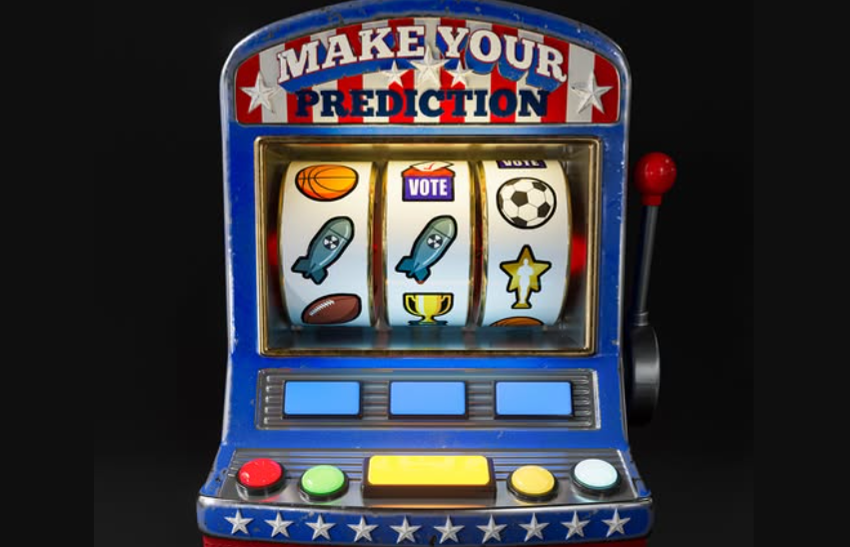
The rapid rise of prediction markets is changing traditional media’s role as a source of news and information…. in the US, at least. Should we be worried?
Will Jesus’ second coming happen before 2027? Prediction market traders have $64.73 million riding on the question.
Elections, interest rate cuts and football are also up for trading. In April 2026, FIFA named ADI Predictstreet its first official prediction market partner, in a multi-year deal worth around $US150 million. And, weddings drive dollars too. Before Taylor and Travis had confirmed a single detail, more than $2.26 million had been traded on where they would exchange “I dos”.
Prediction markets boil down any question to one simple equation: how likely is it?
According to US federal regulators, it isn’t betting. It’s trading. The distinction matters.
On a prediction market, users trade contracts with each other, and prices move with supply and demand, just like a share market. With betting, a bookmaker sets the odds and banks on punters losing.
Prediction market platforms take a small fee on every trade, no matter the outcome. US regulators treat them as financial markets, not gambling, and it’s why they’re overseen by the agency which regulates futures markets.
Few things in modern markets are as divisive. For some, prediction markets offer a direct source to the ‘truth’. Sceptics, on the other hand, say prediction markets have turned almost everything into a bet. That, despite the investment nomenclature, the odds are stacked against the punter.
Good or bad, the influence of prediction markets is not up for debate. What was once a niche hobby for crypto traders has become a mainstay of global capital markets, with monthly trading volumes of more than $50 billion.
Threat to traditional news providers?
Prediction markets platforms aren’t available in Australia, with Polymarket deemed an illegal gambling service since August 2025. In the US, however, prediction markets are changing how information is shared and received. Including the news.
Today, prediction markets pitch themselves as news destinations, not just trading platforms.
Polymarket’s CEO, Shayne Coplan, has called it “the global truth machine” and “News 2.0”. He argues that prediction markets offer live information without the bias that some associate with mainstream media, and that they are true sources of news because:
- Algorithms don’t drive what you see. Everyone sees the same odds, not a feed tuned to keep you clicking or to tell you what you already believe.
- Numbers, not opinions. A market shows one live figure, such as “Democrats 93% to win Congress”. No commentator chooses which story leads, which angle to take or which quote to run. The price is simply what people are willing to pay.
- No advertiser influence. The platforms generate income from trading fees, not ads, so sponsors can’t dictate what a market says or does.
- Accountability. Every market settles on a real outcome so, unlike mainstream media, anyone can check how often the odds were right.
Moreover, prediction markets often beat newsrooms to a story. Rumours, insider tips and local sentiment shift instantly, and the markets with them – no editorial gatekeeper, and no waiting for a network or digital platform to decide when to publish.
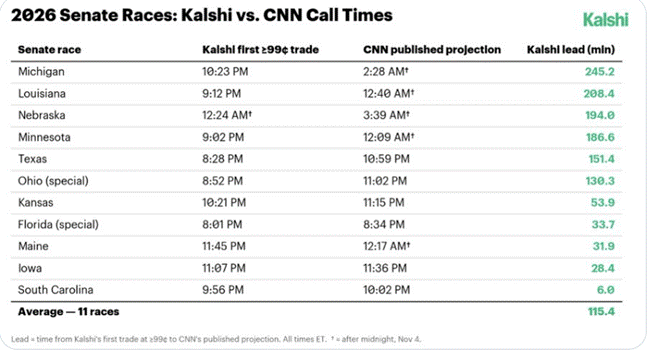
Kalshi says that in key Senate races at the midterms, its markets put the winner above 99% at an average of about 115 minutes before CNN called it.
While not everyone trusts prediction markets as a source of news, plenty are using them for that purpose.
Polymarket averaged about 41m web visits a month in the first seven months of 2026, ahead of Axios (31m) and on par with The Hill (43m).
On election night, an average of 27m people followed the results live across the six biggest US TV networks. Kalshi claims that five people watched its midterm markets for every person who traded. Its midterms page offered race maps, live gauges and House and Senate dashboards so people could follow the night without placing a bet.
Critics warn that this blurs the line between journalism and gambling, and creates conflicts of interest where the networks are both partners and competitors.
Kalshi has deals with CNBC, CNN, Fox News and the Associated Press, and is CBS News’ official prediction market sponsor. CNBC’s deal includes revenue-sharing on new customers and a minority stake in Kalshi, and CNBC hosted a Kalshi-sponsored ‘Trading the Midterms’ conference.
The Wall Street Journal runs Polymarket odds on its homepage through a deal with its publisher, Dow Jones which is owned by News Corp.
Seemingly, we’re a more loyal lot in Australia when it comes to mainstream news, with 43% putting their faith in traditional media, against 36% globally. And, we pay more than most for digital subscriptions. But, the way we consume information is changing with more using social media over traditional news sites.
If live odds become another front door to the news, who owns the audience, and who gets the revenue?
For now, prediction markets price the news. They don’t report it. It’s a critical distinction given that their odds move on polls, scoops and the work of the newsrooms they compete with.
As the Australian Government finalises its News Bargaining Incentive to make Google, Meta and TikTok pay for Australian journalism, it begs the question: should platforms which profit from pricing the news pay for it too?
One thing’s for sure… there’s a market willing to predict the outcome.