‘Boys’ send a not-so-fine message about Wall St

By Nathan Clarke, Practice Director, Six O’Clock Advisory
24 March 2026
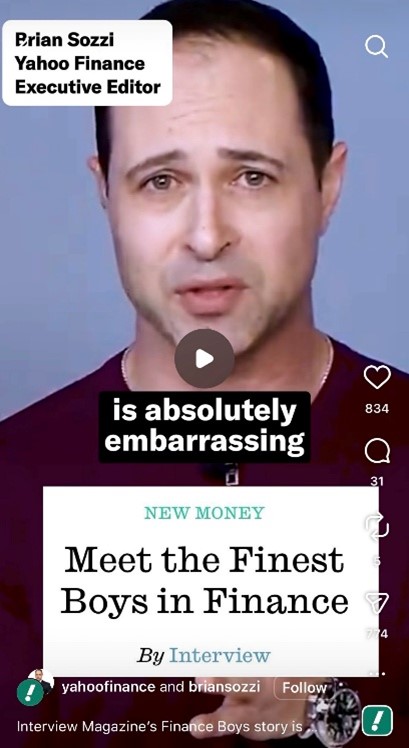
How an organisation’s people represent its brand is critical. Interview Magazine’s Finest Boys in Finance piece serves as a reminder that the basic principles of brand reputation apply regardless of age, place, or time.
For those playing catch-up, this unauthorised piece profiled a group of 20-something so-called finance bros, providing readers a chance to meet some of Wall Street’s “baby-faced” finest.
As the New York Post explained, pictures were staged at Manhattan’s financial district steakhouse Delmonico’s, where the lads “flexed their Celine suits, Hermès ties and Rolex watches.”
Take, for example, 25-year-old Tommy Doherty, member of The New York Athletic Club. Tommy’s drink of choice is none other than a dirty vodka martini with extra olives which he pairs with his dating app of choice, Raya.
He’s flanked by Demarre Johnson ‚ 23, Financial Services Data, Tech, & AI Analyst. Demarre says that, in a good week, he does “maybe 55 hours at the desk”, and he pitches his idea of heaven as “an art gallery with top-shelf wine, strawberry matcha, live jazz, and landscape portraits inside an all-you-can eat sushi buffet with all my kinfolk.”
I know what you’re thinking… very much in the finest tradition of Wall Street’s movers and shakers.
But, is it?
Since the profile piece went live, the lads have become the subject of countless memes and endless social media mockery.
The piece has been slammed across various trade and mainstream news publications as highly embarrassing for their employers and for Wall Street as a collective.
It’s not hard to see why. The world of high finance has a thing about all things fine, coupled with a healthy dose of mystery and intrigue.
In some ways, that is the brand. It’s part of its appeal and, by extension, its employment value proposition.
Large financial institutions often appear mysterious because much of what they do happens behind closed doors, in complex markets, and through networks of relationships that are often invisible to the public.
That combination creates the sense of intrigue that surrounds them. Often it works in their favour. Where the industry has facilitated mystery, it has spawned pop culture, speculation, satire, and gossip.
Sometimes it’s been amusing, and at others offensive. More often than not, it has added further to the intrigue of what life is like, apparently, on Wall Street.
Take Oliver Stone’s 1987 Wall Street. Gordon Gekko, played by Michael Douglas famously said “Greed, for lack of a better word, is good.” Some 30 years later, Martin Scorsese’s Wolf of Wall St took excess and indulgence to all new levels. “My name is Jordan Belfort. The year I turned 26, I made $49 million… which really pissed me off because it was three shy of a million a week.”
And then there’s social media. The famed mock Goldman Sachs Elevator tweets provided an exaggerated take on culture on the trading floor.


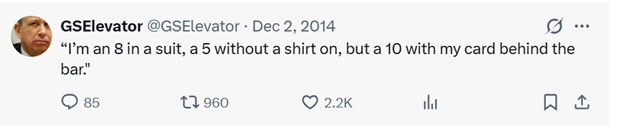
It could be that our finest finance boys are the latest iteration of a long-held tradition.
But there’s a basic difference. Unlike Hollywood interpretations of Wall Street, the so-called finest boys of finance actually work for Wall Street firms.
Unsurprisingly, Goldman Sach’s’ chief apologist was at pains to distance the revered firm from what the story represents.
Turns out, it’s one thing for Hollywood to indulge in intrigue about working on Wall Street, it’s another thing altogether for employees to seek to ‘trade’ on it – particularly when it comes at the expense of their employer’s reputation.

The lads have given a face to the excesses that have come to characterise Hollywood and social media’s take on Wall Street.
Except that, in the case of people like ‘finance’s finest’, they carry the fortunes of clients whose financial wellbeing hinges on integrity, discretion and, dare we say, sound judgement.
It begs the question…. has Wall Street as an entity done enough to shift perceptions (on the assumption that it is even an imperative), or is it happy to tolerate how the likes of the finance bros choose to portray a day in the life of investment banking?
Either way, what we do know is that an organisation’s people represent the brand, and the brand is defined by values and actions.
Wall Street, your move.